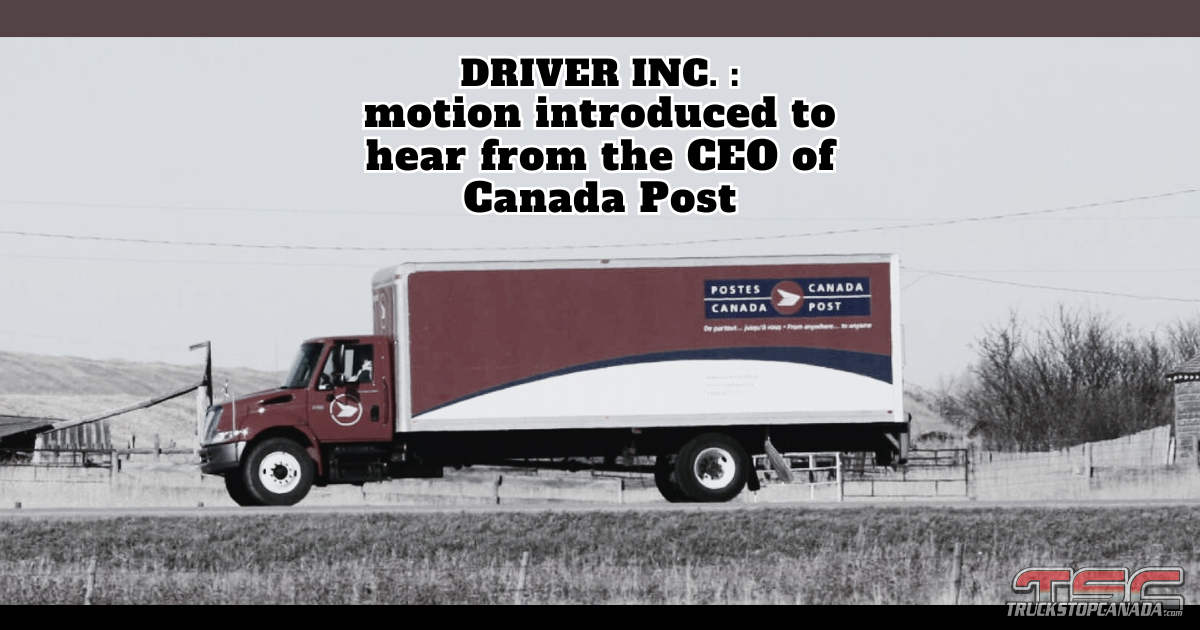





Renewed scrutiny is emerging in Ottawa over whether Canada Post has awarded transportation contracts to carriers linked to the “Driver Inc.” business model—an arrangement increasingly criticized by regulators, law enforcement and industry groups for relying on low-cost drivers who are improperly classified, insufficiently trained, and operating outside established labour and safety frameworks.
If substantiated, the issue raises serious questions about public accountability, given Canada Post’s status as a taxpayer-funded Crown corporation.
The Driver Inc. model typically involves drivers being treated as independent contractors despite having a single employer and no ownership of their trucks. Industry representatives and parliamentary witnesses have repeatedly warned that this structure creates incentives to cut costs at the expense of safety—through inadequate training, excessive hours, poorly maintained vehicles, and, in some cases, invalid permits or insufficient insurance coverage.
These practices have been linked to a growing number of roadside violations, breakdowns and serious collisions across Canada, according to testimony heard at the House of Commons transport committee.
An investigation by La Presse confirmed that at least four trucking companies that delivered intercity mail for Canada Post since 2015 had previously employed drivers under the Driver Inc. model, with as many as twenty others suspected of similar practices—Day & Ross, Gulzar Transport and Gardewine Group Limited Partnership. According to a compilation prepared by the Bloc Québécois and validated by La Presse, seventeen other companies with business ties to the Crown corporation are suspected of having used the same model.
Two of those carriers—Day & Ross and Gardewine Group—were later involved in serious road collisions linked to low-cost drivers. One incident in 2023 nearly claimed the lives of Alexandre Tremblay and Allyson Dumont, a young trucking couple, while another crash in January 2025 killed André Luneau, a driver for TCF Express. In a context where Canada Post is repeatedly accused of awarding contracts to the lowest bidder, critics argue that such procurement practices inevitably open the door to low-quality transportation—marked by undertrained drivers, questionable compliance, and heightened safety risks on public roads.
The human toll of these systemic failures was highlighted during parliamentary hearings by Nathalie Poulin, whose daughter was killed in a 2024 collision involving a heavy truck. Her testimony echoed the concerns of many families and transport professionals who argue that weak oversight allows non-compliant operators to remain active, while compliant companies struggle to compete against carriers offering unrealistically low bids made possible by underpaid labour and regulatory shortcuts.
Bloc Québécois MP Xavier Barsalou-Duval has stated that bids coming in 40 to 50 percent below market rates should immediately raise red flags, as they often reflect labour misclassification, unpaid taxes and compromised safety standards. While Canada Post maintains that it has no direct ties to the Driver Inc. model and that contractors are subject to audits and compliance requirements, its repeated refusal to testify before the transport committee has only amplified calls for transparency—particularly as the federal government continues to inject public funds to keep the Crown corporation solvent.
Following the publication of this article, Bison Transport contacted our media to contest any association with the so-called Driver Inc. model. The company states that it has not used this model and maintains that it has always opposed it. This clarification follows a correction published by La Presse, which reports Bison Transport’s position on the matter. The company’s name has therefore been removed from the article.