

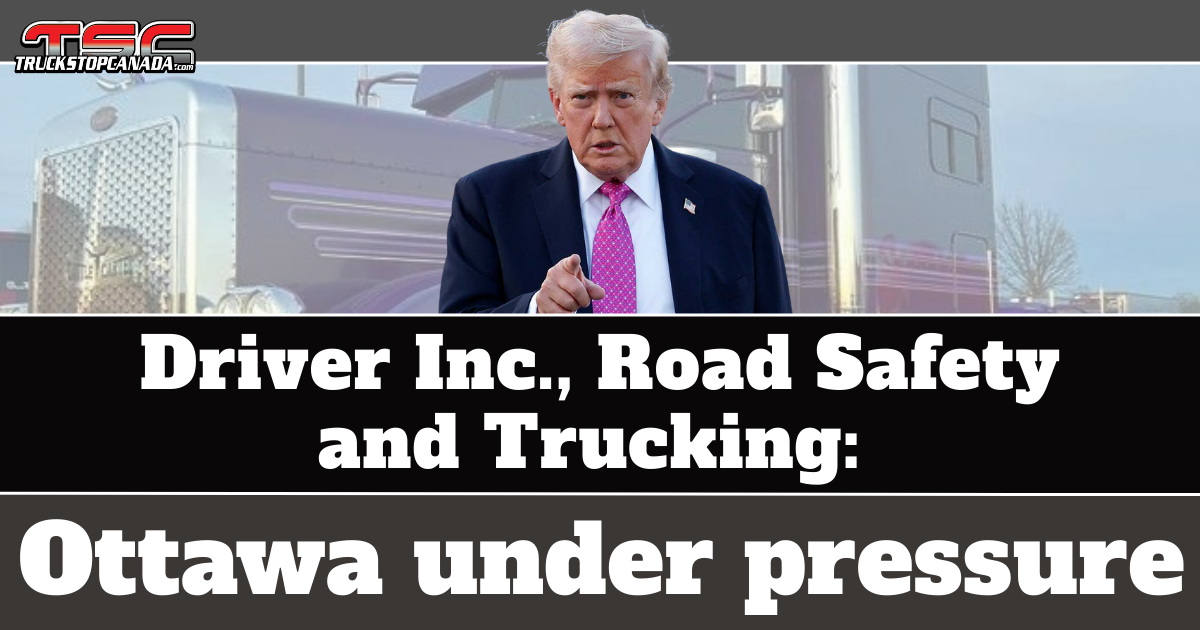
U.S. authorities are sending a clear message to the Canadian government and the trucking industry: the regulatory laxity surrounding certain practices in Canada, including the Driver Inc scheme, poses a real risk to road safety, the labour market and cross-border security.
As the House of Commons Standing Committee on Transport, Infrastructure and Communities continues its study of the Driver Inc scheme, these concerns are now taking on an international dimension. American diplomats closely monitoring the committee’s work have recently expressed serious concerns, noting that issues within the Canadian trucking sector go far beyond taxation alone.
According to U.S. representatives, inadequate driver training, precarious working conditions, unfair competition and even potential risks of cross-border criminal activity are now central issues. They are particularly concerned about road safety as an increasing number of poorly trained drivers operate between Canada and the United States. They also point to the vulnerability of workers who are often heavily indebted and trapped in business models described as unfair. If some drivers are forced to work under such conditions, questions arise about what other activities they could be pressured into participating in.
Canadian Industry Calls for Tighter Rules

On the Canadian side, the Canadian Trucking Alliance (CTA) says it has been sounding the alarm for several years. The CTA is now seeking to work with both Canadian and U.S. authorities to review, and potentially rebuild, cross-border safety programs that ensure fleets and drivers comply with safety, labour and regulatory standards, and operate without links to criminal organizations.
CTA President and CEO Stephen Laskowski recalls that following the September 11, 2001 attacks, security programs were implemented to mitigate transportation-related terrorism risks. He argues that today’s environment requires a new approach adapted to modern realities, including a rigorous screening system for all cross-border carriers and drivers to protect citizens on both sides of the border.
However, road safety and training remain complex issues in Canada due to the division of responsibilities between the federal government and the provinces. Stephen Laskowski acknowledges that this complicates consistent enforcement but notes that discussions are underway. Transport Canada and provincial deputy ministers of transportation have initiated a process aimed at improving trucking safety and harmonizing regulations. The CTA expects announcements related to a national approach during the first quarter of 2026.
The Ontario Trucking Association
In Ontario, the Ontario Trucking Association (OTA) describes the situation as a full-blown crisis of legality affecting both the industry and communities. The OTA is calling for immediate action, including a temporary suspension of the Ontario Immigrant Nominee Program to allow for reforms, 24/7 operation of weigh stations, and systematic carrier inspections similar to those required in the food and restaurant sectors.
According to Geoffrey Wood, Senior Vice-President of Policy at the OTA, the commercial driver licensing system must also be overhauled to more closely resemble a true professional licence. The objective is to protect Ontarians and to demonstrate to Canada’s largest trading partner that trucking is a serious, well-regulated and safe industry.
The OTA says it has already submitted a detailed plan to the Ontario government and supports the CTA’s vision for stricter rules governing carriers and drivers operating across the border.
Quebec Trucking Association

In Quebec, Marc Cadieux, President and CEO of the Quebec Trucking Association (Association du Camionnage du Québec – ACQ), recently met with federal Transport Minister Steven MacKinnon. He emphasized the importance of continuing efforts to make the trucking sector both safer and fairer. While certain adjustments have been made, particularly on the fiscal side with the T4A form to counter the Driver Inc model, Cadieux stresses that many issues remain unresolved.
Interprovincial licensing and recognition continue to pose serious challenges, allowing drivers or carriers to operate in another province despite suspensions or serious violations elsewhere in the country. Cadieux also highlighted to the minister that insurers could play a key role by more effectively sharing information about insured — or no longer insured — companies and vehicles, thereby strengthening oversight and road safety.
Minister MacKinnon has indicated openness to making changes and acknowledges the scale of the challenges. It remains to be seen whether these intentions will quickly translate into concrete action, or whether Canada will continue to lag while the United States moves ahead with sweeping regulatory crackdowns. In California alone, more than 61,000 truck drivers could lose their commercial driver’s licences due to tightened U.S. federal rules, particularly regarding legal status and English language proficiency, illustrating how far authorities are prepared to go.
According to the Trump administration, the era of half-measures is over and Ottawa must follow suit. For industry associations, the time has come to eliminate bad actors in order to secure roads, protect North American supply chains and restore the credibility of a sector essential to the economy.
The Liberals have the power to act. The question now is whether Mark Carney and his government will finally take decisive steps to protect the lives of Canadians on our roads, and whether provincial governments are prepared to assume their share of responsibility for deaths linked to regulatory laxity and negligence that are now widely acknowledged.