

The shooting that took place outside the facilities of HGC (Harman Group of Companies) in Caledon in January—captured on video as two masked individuals repeatedly fired at the building—has become a major wake-up call for many trucking companies in the Brampton area, who now fear extortion and escalating violence.
The Ontario Provincial Police (OPP) later confirmed it was the second attack targeting the same business in just a few weeks.
These incidents reflect a growing concern for law enforcement across Canada, as extortion networks increasingly target trucking and logistics companies, particularly those owned by South-Asian entrepreneurs. What was once viewed as isolated intimidation has evolved into a widespread climate of fear extending beyond local boundaries.
According to figures compiled by Peel Police, reported extortion cases rose from 319 in 2023 to 490 in 2024, followed by 436 cases recorded during the first eleven months of 2025. The tactics range from threatening phone calls and ransom demands to shootings and videos sent directly to victims. Several documented cases involve businesses in trucking in which Punjabi ownership is very prominent.
Police officials have emphasized that these crimes are not the result of internal disputes within the community. Instead, investigators point to organized criminal groups that exploit the high concentration and economic visibility of certain businesses to impose a systematic form of extortion. The federal government recently listed the Indian Bishnoi gang as a terrorist organization, noting its involvement in intimidation, extortion and killings, including activities linked to Canada. However, there is no public evidence indicating that this group is behind all of the extortion incidents reported in Ontario.
The problem is not limited to Peel Region. In British Columbia, particularly in Surrey, South-Asian business owners have reported similar threats that led to multiple arrests. In Alberta, isolated cases have also surfaced in the media. This pattern suggests that the criminal activity expands wherever South-Asian communities are strongly established in commerce, transportation and service industries.
Community leaders interviewed by various media outlets say the issue is not about the ethnicity of the suspects but the vulnerability of the targeted victims: their economic success, geographic concentration and the perception that they have access to capital. This combination makes it easier for criminals to monitor, intimidate and pressure business owners, creating fertile ground for illegal taxation schemes.
Project Outsource
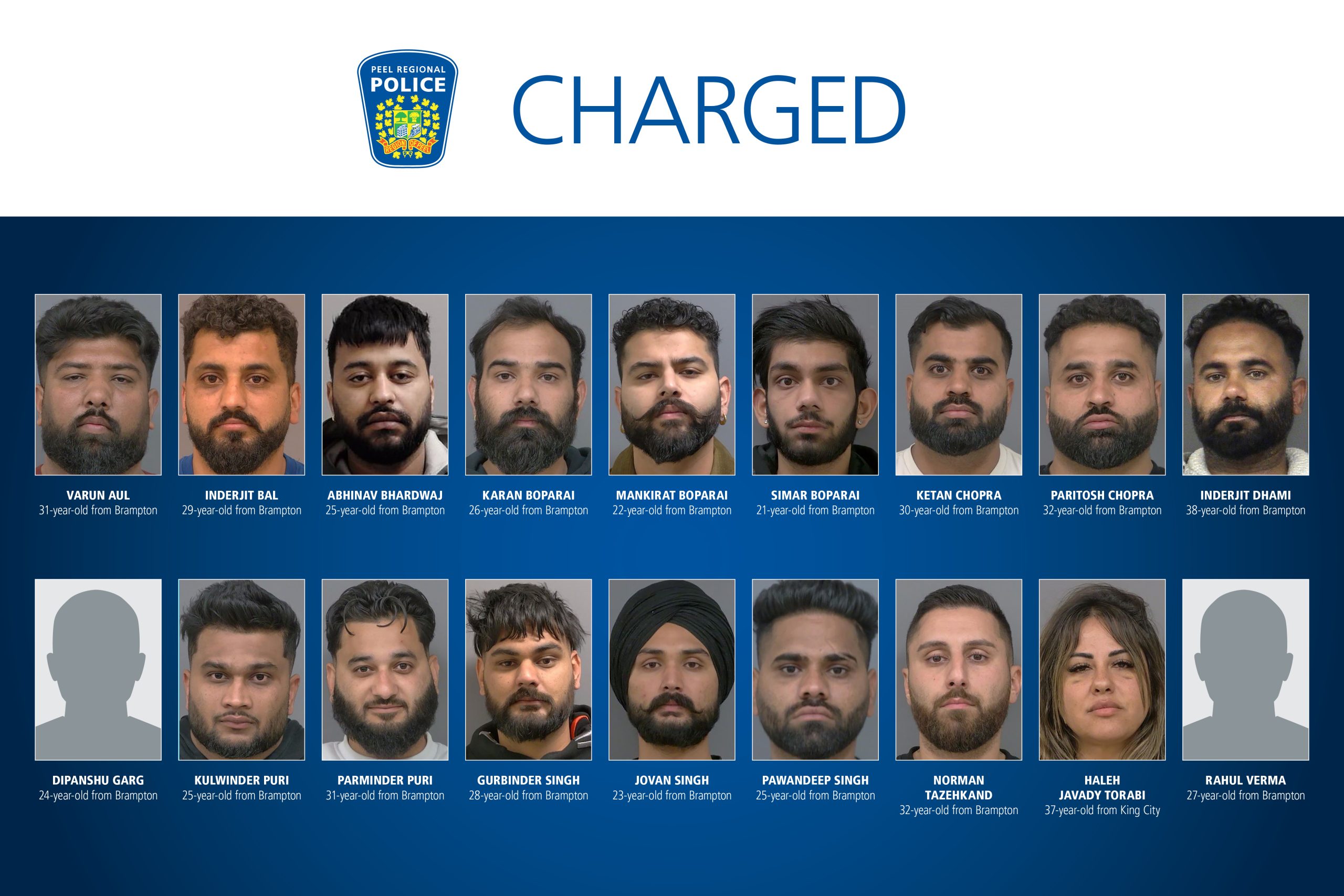
Peel Regional Police recently dismantled a criminal network based in Brampton as part of Project Outsource, arresting 18 individuals accused of violent extortion, fraud and illegal firearms possession. Investigators say the group targeted South-Asian families and businesses and was also involved in insurance-related fraud within the towing sector. Police seized more than $4.2 million in assets, including tow trucks, high-end vehicles, weapons and ammunition. This operation followed the creation of an Extortion Investigative Task Force in late 2023 in response to a wave of targeted intimidation incidents.
Businesses leaving Canada as officials call for action
This climate has pushed several entrepreneurs to consider relocating. Consultant Avi Dhaliwal says up to 70% of Punjabi businesses evaluating a move operate in the trucking sector. Some companies have already re-registered their fleets in the United States while maintaining cross-border operations, choosing states known for stronger crime-reduction policies such as Texas and Florida, according to information shared on RED FM.
In response to the escalating situation, Brampton Mayor Patrick Brown and Deputy Mayor Harkirat Singh are urging both provincial and federal governments to establish a dedicated task force, improve intelligence sharing and increase support for victims. Federal officials have confirmed a January summit involving all levels of government and law enforcement to coordinate efforts. Several elected representatives now view the issue as a national problem extending well beyond the Punjabi community, threatening the stability of key economic sectors — including trucking.
If the situation is not contained, what is currently concentrated in specific communities could evolve into a broader structural risk for the Canadian economy, affecting transportation companies that are not South-Asian owned.
Read More :