
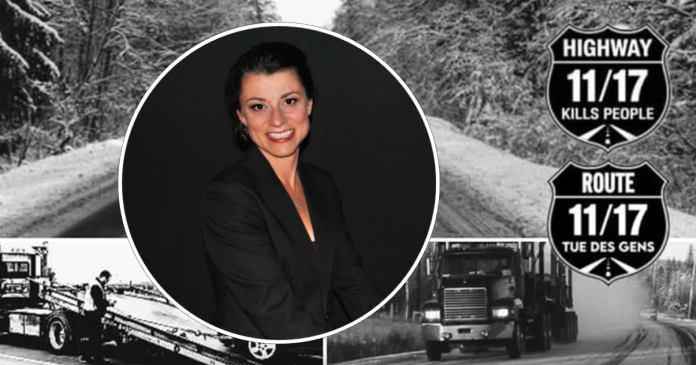
Johanne Baril, Mayor of Val Rita-Harty, a municipality in Northern Ontario, is raising the alarm about serious transportation issues, particularly concerning Highway 11/17. This corridor is critical for the region but has a grim reputation for its dangers.
Road safety concerns, coupled with the exploitation and undertraining of drivers—especially those involved in the ‘Driver Inc.’ schemes—are a nationwide issue in Canada. Various regions face unique but equally pressing challenges, where insufficient oversight and hazardous road conditions significantly impact citizens’ daily lives.
“Things are not going well at all, despite the efforts of Ontario’s Ministry of Transportation. The problems on our roads are massive,” Mayor Baril stated.
A Call to Action Sparked by Tragedy
Mayor Baril played a pivotal role in establishing the Northern Ontario Transportation Task Force, an initiative launched by then-Minister of Transportation Caroline Mulroney. Baril’s advocacy was catalyzed by a devastating incident on January 12, 2022, when a worker was injured after a transport truck executed a reckless overtaking maneuver on Highway 11.
“The transport truck was overtaking, crossing the double yellow line to pass another truck on an incline, in a curve! When the worker saw it, he swerved onto the shoulder. But the shoulder was snowy. At 90–100 km/h, hitting the shoulder at full speed… we all know what happens. He was ejected from his van and found meters away, face down in the snow. That he survived without long-term injuries is nothing short of a miracle.”
This incident, along with three others on the same day—including one fatality—underscored the urgency of revisiting safety standards and better regulating the growing volume of commercial transport in the region.
“I called our Premier Ford directly… that’s when they hit the ‘big button’ to set up the task force, in which I participated.”
Poorly Trained Drivers: A Public Safety Crisis
Mayor Baril has been vocal about systemic issues with poorly trained drivers, particularly those who acquire heavy vehicle licenses through fraudulent means.
“This problem is nationwide. It’s not just Ontario; you know very well this issue exists in Quebec, Manitoba, even big cities. Drivers of heavy trucks don’t always have the proper training to travel across Canada. Unfortunately, road users bear the cost of these accidents.”
Investigations, such as one by CBC Marketplace, revealed fraudulent practices where commercial licenses could be purchased under the table. Immigrant workers, often unprepared for Canada’s harsh winter roads, are frequently the victims of such schemes.
Adding to the crisis, Baril highlighted how companies exploiting these workers impose relentless pressure, pushing drivers to meet unrealistic schedules. Many are forced to work in teams of three, under constant threat of penalties, just to secure payment. This exploitation reflects broader issues, including the infamous ‘Driver Inc.’ schemes.
“It’s outrageous! These workers don’t know what they’re getting into. Companies bring them to Canada, selling them dreams of a good job and life here. But the reality is far from it. These drivers are thrown into the system with zero training—they can’t even back up a truck!”
‘Driver Inc.’: A Dangerous and Costly Loophole
The practices surrounding ‘Driver Inc.’ schemes pose significant risks. These arrangements allow companies to bypass legal and tax obligations, costing provinces billions in lost revenue.
“There’s a lack of courage,” Baril lamented. “It’s disheartening that Canada allows companies to exploit foreign workers while insuring their own trucks through self-created insurance companies. And we let this happen…”
Politicians’ reluctance to address the issue directly perpetuates an unjust system that exploits vulnerable workers while jeopardizing public safety on Canadian roads.
Frustration and Injustice
Ironically, experienced Canadian truckers face stringent requirements to renew their licenses, including vision tests, theoretical exams, and regular medical evaluations. Meanwhile, inadequately trained drivers, often new immigrants, are allowed on the roads ‘unchecked’.
“Our good truckers struggle to renew their licenses, while fraudulent companies throw untrained newcomers into heavy trucks. It’s frustrating,” Baril said.
This disparity fuels resentment within the industry and increases social tensions.
A Call for Uniform Standards
Mayor Baril emphasizes the urgent need to standardize training and evaluation requirements for commercial drivers across Canada, suggesting mandatory tests supervised by provincial representatives.
“We should set a timeline. For example, within a year, all truck drivers must pass a driving test—not on company property, but with a provincial representative.”
In February 2023, the Northern Ontario Transportation Task Force presented recommendations, including widening certain roads, improving rest areas, and enhancing driver training. However, Baril notes that these suggestions have been lost in bureaucratic delays.
“Since then, nothing. We’ve heard nothing. And in the meantime… we’re all afraid to drive. It’s obvious,” she said.
A Crisis in Waiting
“Canadian ports go on strike and get attention. Do we need to shut down our highways to make provinces work together? What we’re doing now isn’t working. How do we ring the alarm?”
Without immediate action, Baril fears more lives will be lost before significant change is implemented. This crisis continues to place an emotional and physical strain on residents, truckers, and road users alike.
Radio interview (in French only)
(Please note that Mrs. Baril’s statements were translated using a translation program.)