


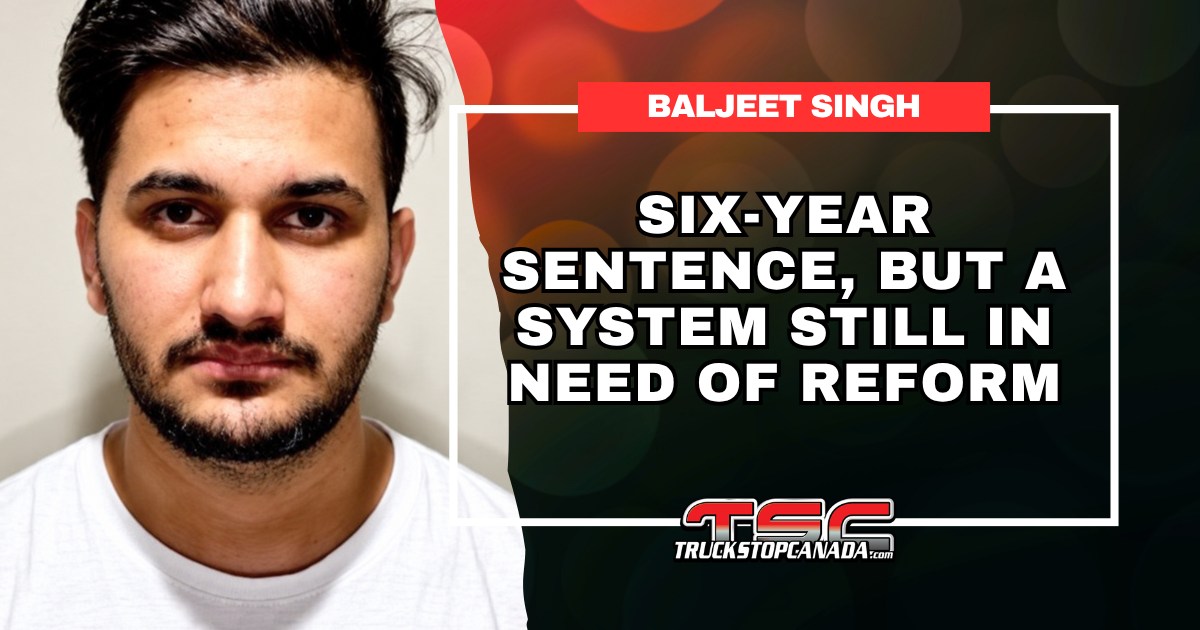
Truck driver Baljeet Singh was sentenced on September 30 at the Longueuil, Quebec courthouse, more than four years after the multi-vehicle crash that claimed the lives of 42-year-old Nancy Lefrançois and her 11-year-old son, Loïc.
Singh was sentenced to six years in a federal penitentiary. After credit for time already spent in custody, he has four years and four months left to serve. He was also prohibited from driving for 10 years.
The judge accepted the joint sentencing recommendation submitted by the Crown and defence. He noted that the sentence, for dangerous driving causing death and bodily harm, ranks among the more severe penalties generally imposed for this type of offence.
For the victims’ family, however, the sentence remains difficult to accept. That frustration is also shared by some within Canada’s trucking community, where concerns have been raised for years about inadequately qualified drivers and whether existing penalties provide enough deterrence.
In their view, the sentence remains too lenient considering the devastating consequences of the crash.
A deadly multi-vehicle crash
The tragedy occurred on July 19, 2022, on Highway 30 in Brossard, Quebec.
As traffic slowed near a construction zone, the 53-foot tractor-trailer driven by Singh struck vehicles that were nearly stopped ahead of him. Evidence presented in court showed that Singh was using his cellphone and playing an online game at the time of the collision.
Singh committed 43 violations of Quebec’s Highway Safety Code that day and had also exceeded the maximum number of driving hours permitted under hours-of-service regulations. Several other people were injured in the crash.
At the time of the crash, Singh was driving for Harman Transport, an Ontario-based trucking company.
In April, Singh pleaded guilty to charges of dangerous driving causing death and dangerous driving causing bodily harm.
But the case took another painful turn for the family.
Less than 24 hours after the crash, Singh left Canada for India, before criminal charges had been laid. He remained outside the reach of Canadian authorities for more than three years.
He was eventually located in the United States, where he was attempting to return to work as a truck driver. U.S. authorities arrested him in August 2025, and he was subsequently returned to Quebec.
After sentencing, the fight to change the rules continues
With the criminal proceedings now concluded, Mélanie Séguin, Nancy’s stepmother, intends to continue another fight: reforming Quebec’s public automobile insurance system.
She is challenging rules that can allow a person convicted of a criminal offence arising from a collision to remain eligible for certain benefits related to injuries or lasting impairments suffered in that same event.
Quebec operates a public no-fault automobile insurance system, administered by the Société de l’assurance automobile du Québec (SAAQ). Unlike systems in some other Canadian provinces, compensation for bodily injuries is generally based on the fact that a person was injured in a motor vehicle collision, rather than on who was legally responsible for causing it.
As a result, a person may remain eligible for certain benefits even when they were responsible for the crash.
When someone is incarcerated for a criminal driving offence, income-replacement benefits can be reduced. However, incarceration does not automatically eliminate every form of compensation available under the provincial system.
For Séguin, the Singh case illustrates what she sees as a fundamental weakness in the current framework.
She is calling for the rules to be reviewed when a driver is criminally convicted, arguing that it is difficult for victims’ families to accept that convicted offenders may retain access to certain benefits while those left behind live permanently with the consequences of the tragedy.
She also argues that families of victims do not necessarily receive comparable long-term support.
Lawyer Marc Bellemare has criticized this aspect of Quebec’s system for years, arguing that reforms have been repeatedly discussed without being adopted.
For those seeking changes, the issue goes beyond the internal administration of the SAAQ. It raises a broader question about Quebec’s public insurance model: under what circumstances should money collected from drivers through licence and vehicle-registration fees continue to compensate someone who has been found criminally responsible for conduct connected to a deadly collision?
Drivers can still leave the country
The case has also raised questions about the mechanisms available to prevent a driver involved in a fatal collision from leaving Canada or returning behind the wheel while a police investigation is still underway.
Throughout the years that followed the crash, Séguin continued pressing governments for changes.
In January, she travelled to Ottawa to testify before the House of Commons Standing Committee on Transport, Infrastructure and Communities.
Among the changes she called for were reforms to work-permit rules and a mechanism that could, under certain circumstances, allow authorities to temporarily retain the passport or other travel documents of a person involved in a fatal crash while an investigation is ongoing.
Singh’s case exposed an especially painful gap for the family.
At the time of the collision, no measure prevented him from leaving Canada. For Séguin, his departure added more than three years of uncertainty, waiting and legal efforts to a loss that was already unimaginable.
Her campaign now extends beyond what happened to Nancy and Loïc. She wants to prevent another family from watching a driver involved in a fatal collision leave Canada before authorities can complete their investigation and, when justified, impose conditions.
The sentence handed down this week therefore marks an important step, but it does not completely close the case.
The next question is whether governments will consider changes surrounding the temporary restriction of passports or other travel documents during certain criminal investigations, and whether Quebec will eventually reform its automobile insurance system to better reflect situations involving criminal conduct while giving greater consideration to victims and their families.