

Driver Inc., illegal truck yards, shootings and organized crime | A couple of years ago, would anyone have imagined police helicopters flying over residential neighbourhoods in Canada in search of stolen trucks?
Gunfire targeting homes and businesses? Dozens of properties illegally turned into truck yards in the middle of communities where families live?
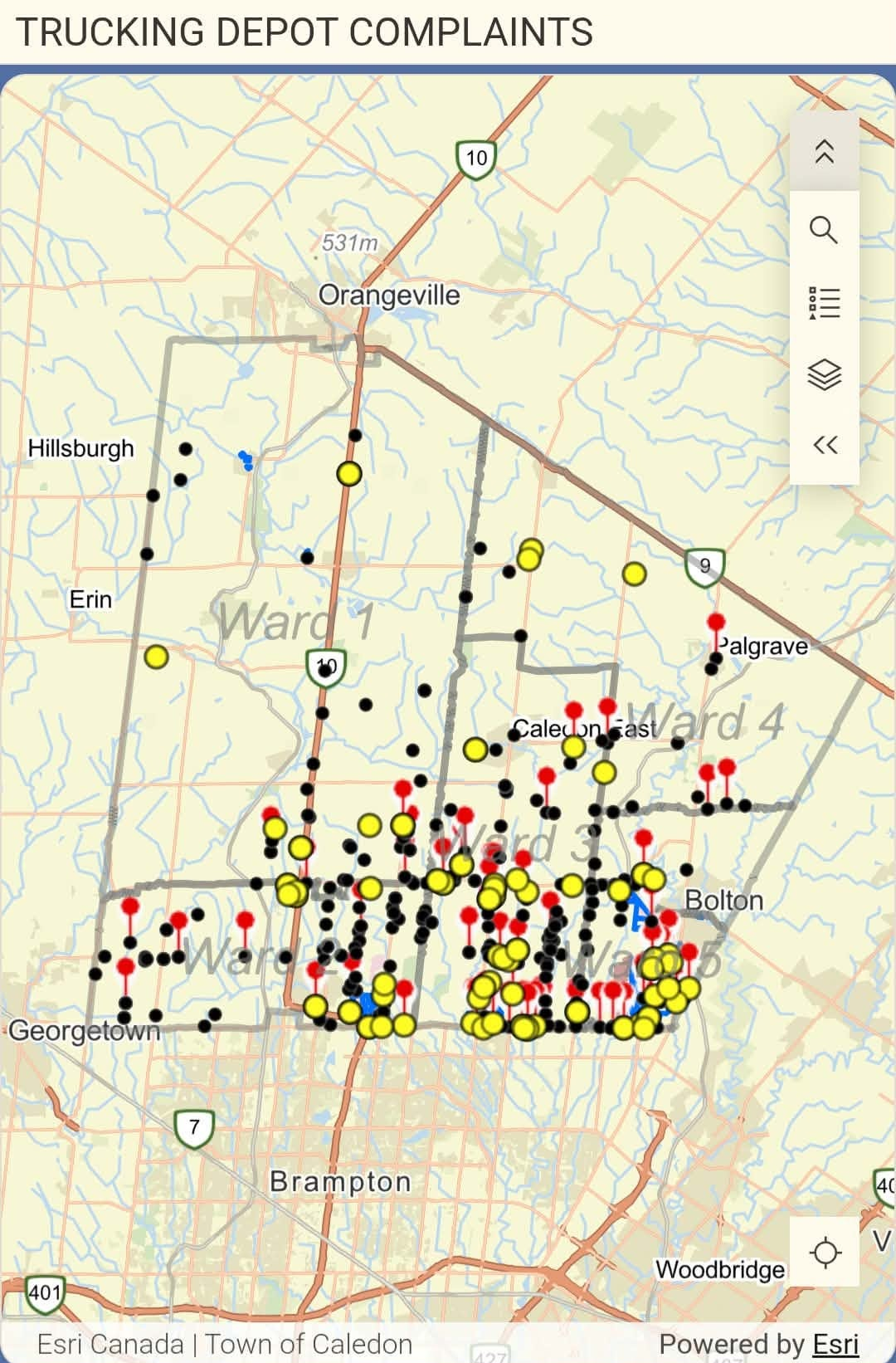
Yet this is the reality residents of Caledon, in Ontario’s Peel Region, are facing today. Once known for its rural character, the municipality now finds itself at the centre of illegal trucking activity that goes far beyond a simple zoning issue.
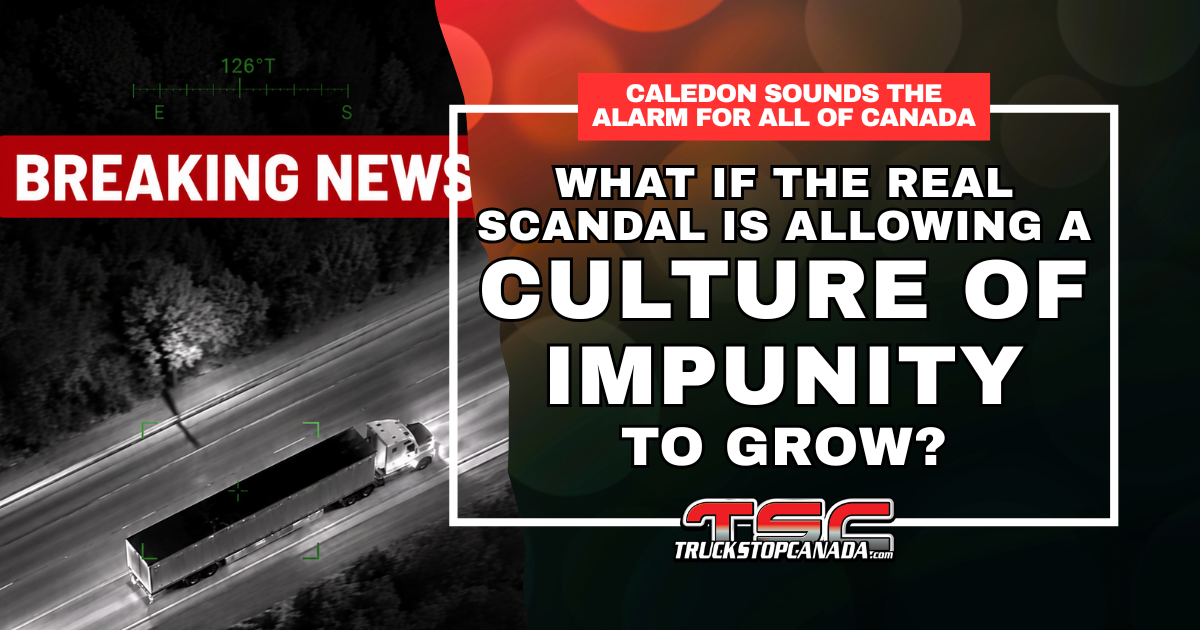
Last July, York Regional Police used its Air2 helicopter to track a stolen commercial truck (video at the end of the article).
« The video footage was from July 2nd and involved a stolen commercial truck takedown near Morra Avenue, which is on the border of Caledon and Vaughan. This location is a mixed area of residential neighborhoods and truck yards, many of which have simply been set up on farmland on the Vaughan side of the border, » Carmela Palkowski of the Caledon Community Road Safety Advocacy Group (CCRSA) told Truck Stop Canada.
As police followed the vehicle from the air, the two suspects abandoned the stolen truck and fled on foot through residential backyards. Police eventually found them in a resident’s backyard.
« What if residents had been having a BBQ, kids had been playing in the yard, or their backyard doors had been open? These are the kinds of questions that are leaving residents in Caledon extremely anxious, » she added.
Two weeks later, helicopters and police once again shut down the same stretch of road.
« There is still no information as to what happened or what the plan is moving forward for this area, which has left the community feeling unsafe, » Palkowski said.
For residents, these incidents are part of a situation that has been deteriorating for years: a growing number of illegal truck yards, companies that are difficult to trace, extortion, shootings and mounting safety concerns despite repeated warnings.
Palkowski also denounces the way some truck yards that operated illegally eventually obtain temporary zoning approvals.
« The municipalities keep granting ‘temporary zoning’ to truck yards that have been operating illegally. For example, a few months ago, a truck yard on the Vaughan side requested temporary zoning after operating illegally for years. »
The CCRSA raised concerns about a centre median at the entrance to the yard, which forces truck drivers to enter oncoming traffic in order to travel in the opposite direction.
« The CCRSA pointed out that there is a centre median at the entrance to this yard, and truck drivers need to drive into oncoming traffic in order to travel in the opposite direction. Vaughan Council approved it. As a result, trucks now make U-turns and enter oncoming traffic at this yard every day. »
A culture of impunity?
The issue had already reached Ottawa in January as part of a study by the House of Commons Standing Committee on Transport, Infrastructure and Communities (TRAN) examining the evolving circumstances facing truck drivers in Canada. The committee’s work addressed the Driver Inc. model, non-compliance within the industry and the consequences for road safety.
The CCRSA was invited to testify after Bloc Québécois MP Xavier Barsalou-Duval called on the committee to hear from victims of heavy-truck crashes and groups dealing directly with troubling practices within the industry.
The CCRSA described Caledon — one of the municipalities in Peel Region alongside Brampton and Mississauga — as one of the epicentres of Driver Inc., while also denouncing numerous illegally operated truck yards, companies that are difficult to trace and businesses that change names or jurisdictions.
Asked by Truck Stop Canada about the situation in Caledon, Barsalou-Duval said the failure to enforce existing laws, along with insufficient resources given to enforcement authorities, has contributed to the deterioration of the situation.
« The case of low-cost drivers (Drivers Inc.) is the perfect example of what can happen when we give up on enforcing the laws, or when authorities are not given sufficient resources to enforce them. The situation has deteriorated to the point of a loss of control, the development of a culture of impunity and a widespread defiance of the rules, » he said.
For the MP, the connections he has observed between certain illegal truck yards and supporters of the Driver Inc. model illustrate how different forms of non-compliance can overlap.
« Based on my research, some companies operating illegal truck yards in the Caledon area appear to be connected to CTOA, the Ontario lobby group that advocates in favour of the ‘Driver Inc.’ model. It is not surprising that individuals who are already breaking certain rules would break others as well, » Barsalou-Duval added.
The Bishnoi file
Adding to an already troubling picture are recent revelations concerning the Bishnoi gang, a transnational criminal organization originating in India that Canada has listed as a terrorist entity. In Canada, the group has been associated with extortion networks, shootings and arson.
« The recent Global News revelations about a criminal organization from India that allegedly took advantage of Ottawa’s lax approach to issuing visas are extremely concerning, » Barsalou-Duval told Truck Stop Canada.
A Canada Border Services Agency intelligence report obtained by Global News also assesses that the Bishnoi gang and other criminal groups likely have significant ties to the trucking industry.
No direct link has been established between the Driver Inc. model and the Bishnoi gang. Barsalou-Duval nevertheless points to the geographic concentration of both phenomena in the Brampton area.
« Whether these two phenomena are connected or not, they clearly help explain the growing sense of insecurity in this part of Ontario, » he said.
The situation therefore goes far beyond a handful of agricultural properties being illegally used to park trucks. In Caledon and around Brampton, concerns now include tax and regulatory non-compliance, companies with structures that are difficult to trace, illegal truck yards, inadequate driver training, extortion and organized crime.
The Town of Caledon has imposed penalties, but given the scale of the problem, one question remains: has Ottawa lost control of the situation, or is there simply a lack of political will to respond at the level required?
« In my view, the only thing that can explain why the Liberals are doing so little on this issue despite the never-ending scandals is their electoral interest, » Barsalou-Duval replied to Truck Stop Canada.
What is happening in Caledon is no longer a local problem. Northern Ontario communities have already been living with the consequences of a trucking industry in crisis, where repeated fatal crashes, unsafe driving and chronic highway closures have left residents fearing for their lives on roads they depend on every day. Driver Inc. has also caused serious damage far beyond Peel, families in Quebec have already paid a devastating price on our roads, and the Bishnoi gang has an established presence in Western Canada. These are no longer isolated regional problems. They are symptoms of a trucking system that is sick, and of a country that has waited far too long to confront it.
Before illegal truck yards, shootings and police helicopters searching for stolen trucks become the reality of more Canadian communities, Caledon’s fight must become our fight. All of ours.
A petition for change
Alberta has recently taken a much tougher enforcement approach, removing 20 unsafe carriers from the road, including 13 chameleon carriers, blocking another 40 suspected chameleon carriers from obtaining Safety Fitness Certificates, issuing 443 administrative penalties and shutting down five fraudulent Class 1 driving schools. The province is also specifically targeting Driver Inc. schemes.
The CCRSA is now preparing a petition calling on the Ontario government to follow Alberta’s lead and strengthen enforcement against unsafe carriers, chameleon carriers, Driver Inc. schemes and fraudulent truck-driving schools. An MPP has already agreed to present the petition at Queen’s Park. The group will also be present at Bolton’s Midnight Madness on August 14.