


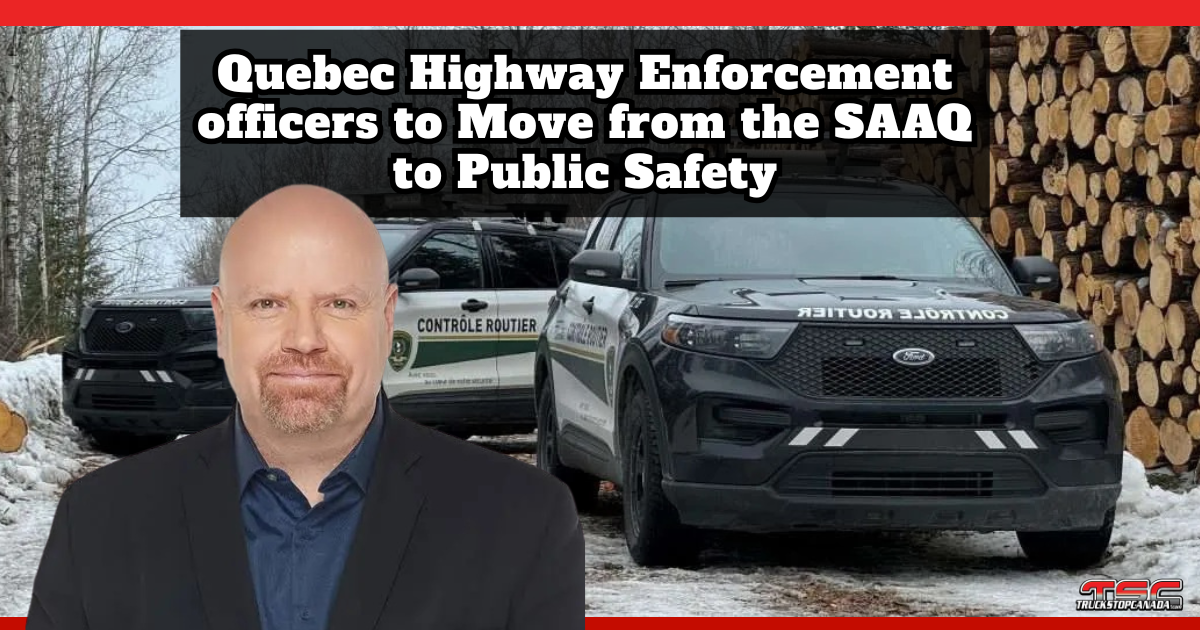
Quebec’s highway enforcement officers will be transferred from the Société de l’assurance automobile du Québec (SAAQ) to the province’s Ministry of Public Security as of January 2027, pending the adoption of Bill 13.
The announcement was made earlier today at the Quebec National Assembly by Public Security Minister Ian Lafrenière and Transport and Sustainable Mobility Minister Jonatan Julien. Both ministers said they are confident the legislation will be passed.
According to Jean-Claude Daignault, president of the Fraternity of Quebec Highway Control Officers (FCCRQ), the government is amending an existing bill rather than introducing new legislation, a process that has already been approved by cabinet. With the governing Coalition Avenir Québec holding a majority, the transfer is widely seen as a near certainty.
The reform is intended to refocus the SAAQ, a Quebec Crown corporation, on its role as the province’s public automobile insurer. The government also says the move will strengthen enforcement operations by placing highway officers within a ministry that oversees police services and public safety agencies, including the Sûreté du Québec.
Marc Cadieux, president and CEO of the Quebec Trucking Association (ACQ), said his primary concern is how the transition will be managed, particularly with respect to data sharing and operational continuity. He said the association will closely monitor the process to ensure highway enforcement officers continue to focus on road safety, regulatory compliance and fair competition in the freight transportation sector.
Highway enforcement officers have shifted between several administrative authorities over the years, previously reporting to the Ministry of Transport and, at one point, the Sûreté du Québec. Stakeholders say the move to Public Safety provides clearer oversight for a corps that exercises peace-officer powers.
Last October, the government announced that highway enforcement officers would be authorized to carry a service firearm as part of a broader plan to enhance their safety while working on the road network. The transfer to Public Safety is seen as a continuation of that policy direction. Officers will be sworn in again under criteria adapted to their duties and will continue training at the École nationale de police du Québec. They will also gain expanded access to the Quebec Police Information Centre, allowing for improved situational awareness during roadside inspections.
The government says the reorganization will not result in additional costs and is aimed at improving operational effectiveness.
The Quebec Professional Towing Association (APDQ) also welcomed the announcement. Its CEO, Réjean Breton, said the transfer should have taken place years ago, regardless of whether officers were armed. He added that a stronger presence of highway enforcement officers is needed to address road safety concerns, particularly involving heavy vehicles operating without adequate oversight.
Daignault noted that the reform had long been recommended, including by coroner Luc Malouin following the fatal Des Éboulements bus crash. He said reporting to a Crown corporation complicated decision-making and accountability, while the move to Public Safety is expected to streamline authority and operations.
The transfer is also expected to improve public recognition of highway enforcement officers’ authority and responsibilities. While some officers learned of the announcement through social media before receiving formal notice, the government says it is aware the transition may raise concerns and has committed to keeping stakeholders informed as the process moves forward.