
Truck Driver Rajwinder Singh Sentenced to 55 days in jail for taking Adrianna’s life | For some years now, Quebec has been shaken by a series of crashes involving heavy trucks and poorly trained drivers.
But to grasp the scale of the problem, one only has to look toward Ontario, where entire communities live with this reality every single day.
In the Greater Toronto Area, particularly Brampton, Vaughan, and Caledon, residents contend daily with relentless truck traffic and dangerous practices that constantly put their safety at risk.
Adrianna Milena McCauley — another name that must become a catalyst for change
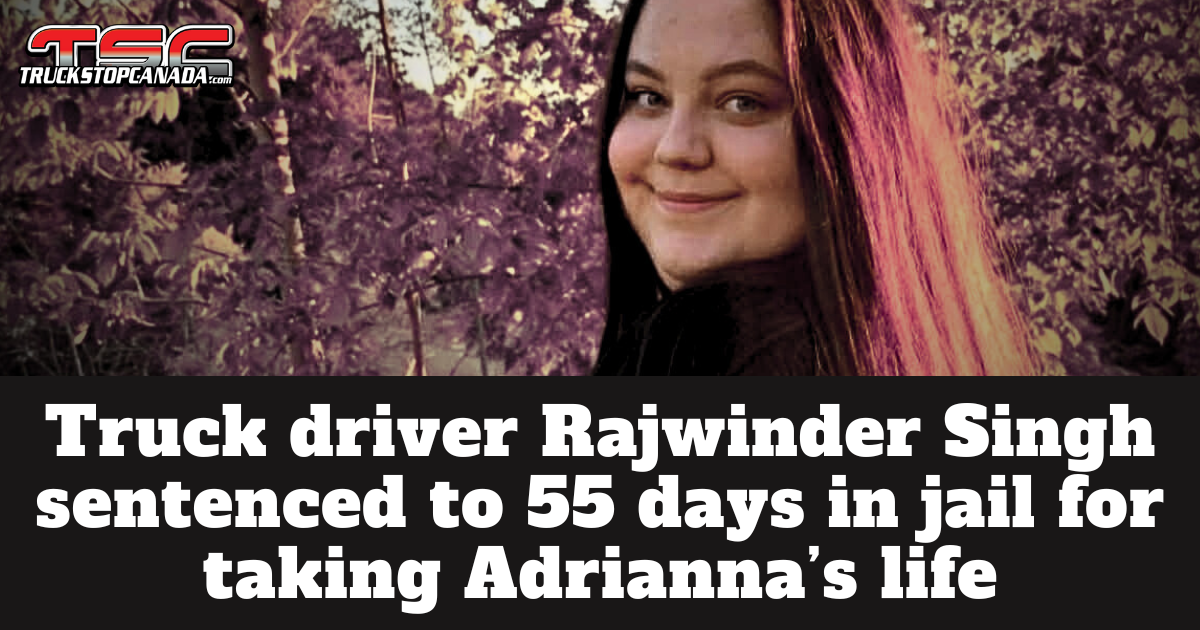
On January 5, 2026, the Caledon Provincial Offences Court sentenced 43-year-old truck driver Rajwinder Singh to 55 days in jail for careless driving causing the death of Adrianna Milena McCauley, a young Bolton woman killed in 2024. The sentence also includes 24 months of probation with mandatory counselling, a three-year driving suspension, and a $1,000 fine, adjusted due to Singh’s financial instability.
Singh had pleaded guilty in October. His truck entered an intersection nearly 10 seconds after the light turned red, violently striking the 23-year-old woman’s vehicle. The road was dry, visibility was perfect, and nothing external explains the fatal delay.
The court emphasized that commercial drivers hold a significantly higher duty of care than regular motorists. Justice Marsha Farnand highlighted the unusually long delay before impact, arguing that the custodial sentence was necessary for denunciation and deterrence. According to her, running a red light for several seconds while operating a 40-ton truck can cost a life — and must result in a severe penalty. Singh, speaking through an interpreter, apologized and said he will never drive a truck again.

“We are so frustrated with the outcome of this sentence. Adrianna was a beautiful young woman, in the wrong place at the wrong time. Her life wad ended by a reckless act of an individual who ran a red light in a transport truck,” said Carmela Anzelmo-Palkowski, of the Caledon Community Road Safety Advocacy (CCRSA) Group, to Truck Stop Canada. CCRSA reports seeing commercial trucks speeding, ignoring signs, and blowing red lights on a regular basis.
“Adrianna’s mother, fiancée, brother, family and friends rights have been trumped by an asylum seeker to Canada who is now on social assistance and needs therapy. How is that ok? Our justice system is broken!” she adds.
Illegal truck yards at the heart of the community
In Caledon, another major issue overlaps with the accidents: the explosion of illegal truck yards. These makeshift parking lots — often set up on agricultural, rural, or vacant land — operate outside industrial zoning, without permits, without supervision, and without proper infrastructure.
Heavy trucks travel through areas where they are prohibited, drive too fast, run red lights, and maneuver dangerously near homes and schools. This phenomenon, driven by the shortage of industrial land and insufficient inspections, has created a constant climate of insecurity for families who live with the fear of another tragedy every day.
Municipalities struggle to shut down these illegal yards because they must go through long, costly civil procedures. Each enforcement action can take years, draining municipal resources and allowing operators to continue running their businesses throughout the entire process.
To make matters worse, authorities now report recurring problems involving shootings, threats, and extortion linked to some of these illegal yards. The situation has moved far beyond zoning disputes — and without stronger tools, more staff, and real deterrents, municipalities are being overtaken by a problem that evolves faster than regulations can keep up.
Honouring victims through courageous and necessary decisions
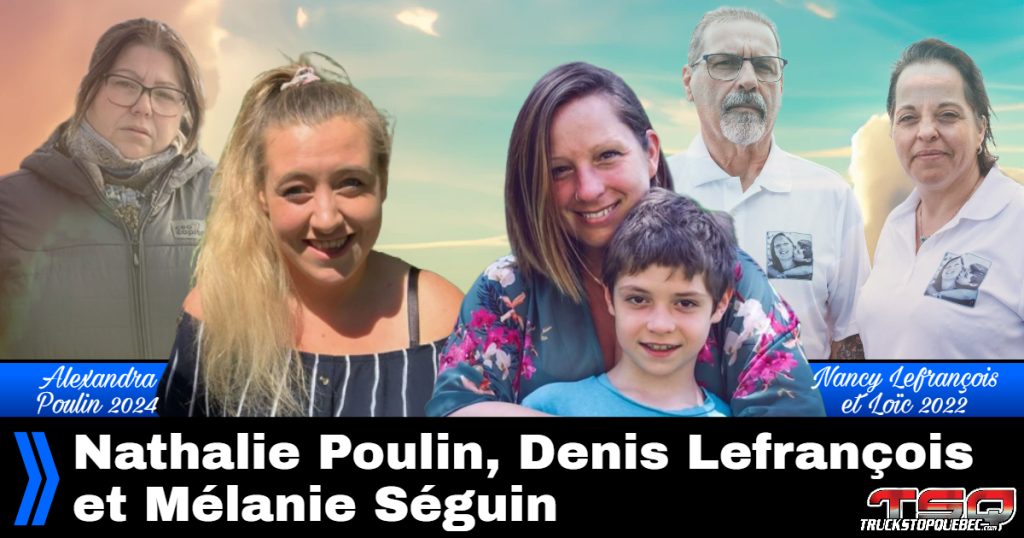 Tragedies such as those that claimed the lives of Alexandra Poulin, Nancy Lefrançois and her son Loïc, in Quebec, and Adrianna McCauley in Caledon, point to a deep national crisis. So do the deadly collision near Altona, Manitoba — where Navjeet Singh is accused of killing a mother and her eight-year-old daughter — and the infamous Humboldt Broncos bus disaster in Saskatchewan. Different stories, but the same pattern: systemic failures, negligence, and missing safeguards putting entire families at risk every day.
This is not just a fiscal issue. The parliamentary study led by Xavier Barsalou-Duval must be taken seriously and lead to rapid, concrete, and far more ambitious measures than what we’ve seen so far.
“Initially, I thought this was an isolated problem. But when I spoke with people from Brampton and Caledon who deal with this every day… Trucks everywhere, taking over farmland, no road safety… I realized it was much bigger than I thought. Seeing companies operate like they make the law themselves is frightening,” explains Barsalou-Duval, who, despite being a Bloc Québécois MP, has gained support from industry stakeholders and community members across Canada for his work on this issue.
Media must investigate what is happening in Caledon, track the progress of this parliamentary study, and accurately report what is taking place on Canadian roads. And the problems extend far beyond individual crashes. The situation in Northern Ontario alone represents an unprecedented crisis — one that is unworthy of a major national corridor.
Along Highways 11 and 17, fatal collisions occur with alarming regularity, exposing deep gaps in training, infrastructure, maintenance, and oversight. These are not remote backroads; they are essential arteries for travel, trade, and the movement of goods across the country — a route often described as a trans-Canada lifeline. Yet it remains dangerously underbuilt, inconsistently maintained, and chronically overlooked.
- What’s happening in Northern Ontario? Join Hwy 11/17 kills people – La route 11/17 tue des gens
These failures are multiplying from east to west, creating a national pattern that can no longer be dismissed as isolated incidents.
This crisis is not only about road safety — it is also about an immigration system with structural gaps that leave some workers vulnerable to exploitation. Unscrupulous companies take advantage of administrative loopholes and insufficient oversight to impose dangerous conditions on drivers who may not speak our official languages, lack proper training, and in some cases are not even paid.
And at the center of all of this, we must never forget the true victims — those who lose their lives and the families left behind with a void that can never be filled. One day, those in power who continue to look away will have to answer for the lives that were lost under their watch. We pay them to act — not to wait.